

The Brick Wall of Frustration & How to Get Around It
The Hidden Stages of an Idea
With any idea, there is a process. Each and every idea goes through six stages, plus a few shoot-off options, and it ends up revealed in the world. Maybe it's an idea for a business, for a lifestyle change, or when to go to the grocery store tomorrow.
At only stage two, we hit the brick wall of frustration. That's right. You might bask in the euphoria of a new idea, big or small, only to hit an obstacle you cannot find your way around just around the corner. Maybe you don't have time, funds, or enough courage to make it happen. Everyone faces one brick wall of frustration or another.
The fact of the matter is that there is always a brick wall at stage two. If the idea is something we've done a lot in the past, getting around the obstacle is easy. If I can't get to the grocery store, I've got options figured out like Instacart or asking someone in my household to go. But a bigger idea can be more of a challenge.
THE WALL DOESN’T MEAN STOP. IT MEANS FIGURE IT OUT.
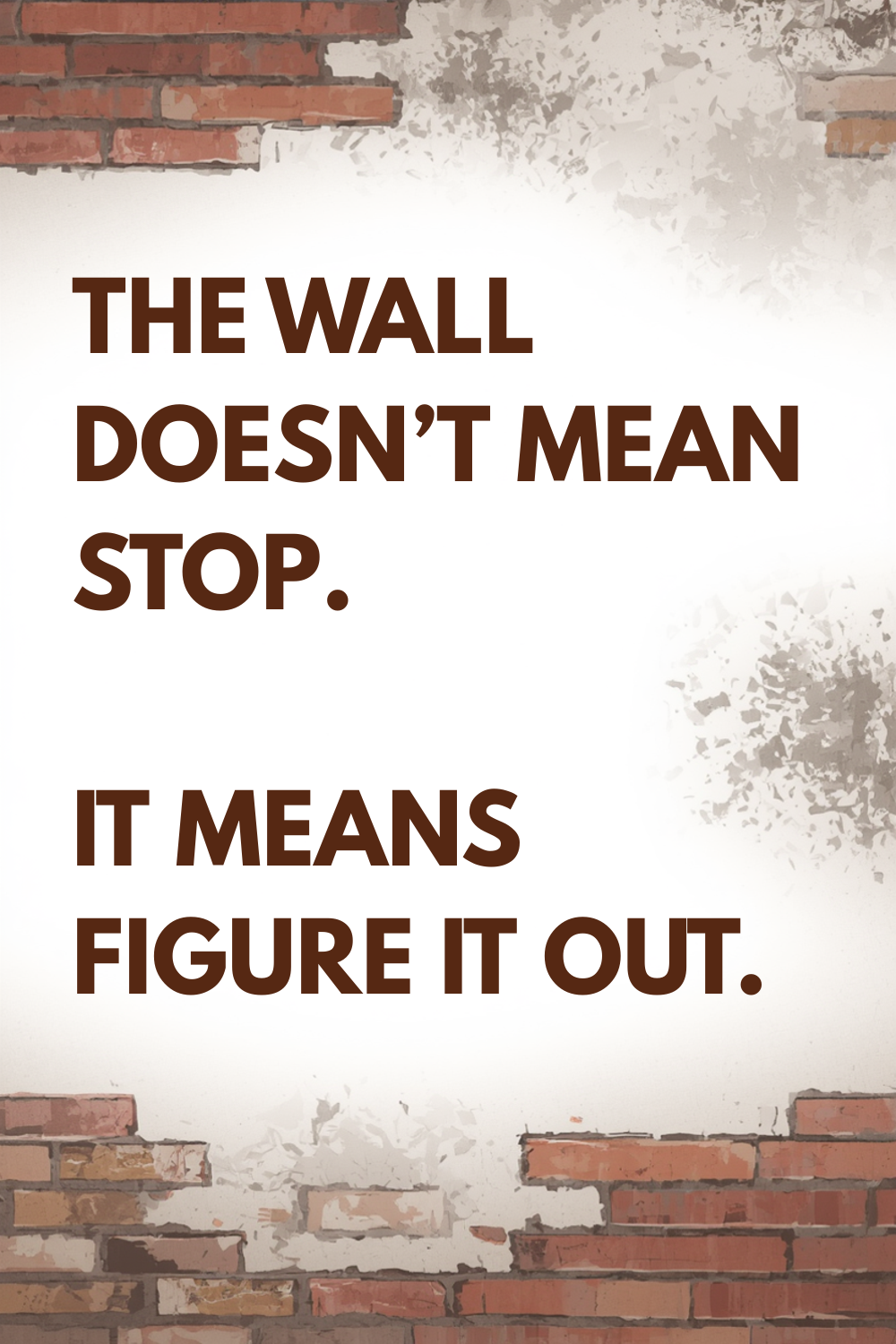
Running into the obstacle, the brick wall of frustration, stops most people cold in their tracks.
Defeat sets in immediately. They don't know to expect this frustration. They think it's something they've done or something about them.
It's not.
The brick wall of frustration is part of the process. Getting around it is what this article is about.
The Myth of Linear Progress
Most of us are taught—explicitly or implicitly—that growth should be linear.
Have an idea. Take action. See results.
This linear path to success is a lie. There is so much chaos between the idea and taking action!
Growth looks like this:
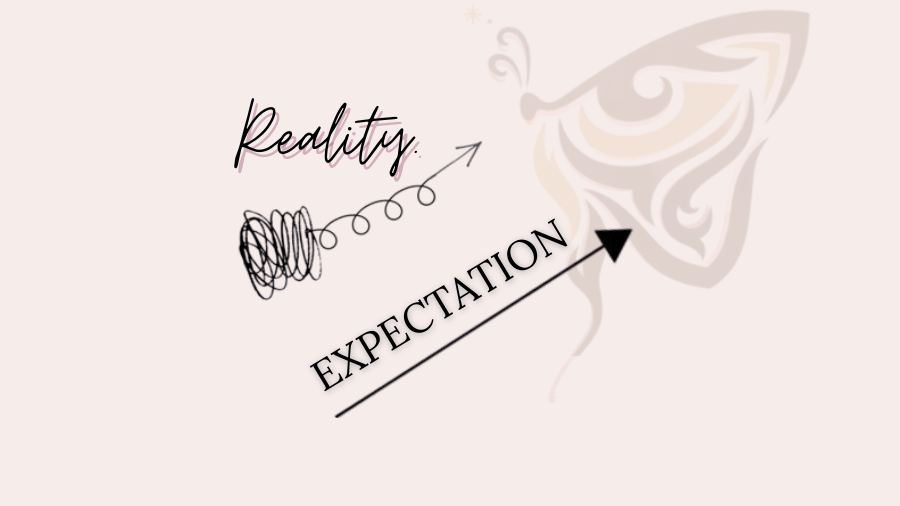
Growth is truly chaotic though we expect it to be linear.
Growth is chaotic, it runs in circles, it reaches high and low, and then it climbs before it steadies or balances into a linear fashion.
So when clarity disappears or momentum stalls, frustration sets in fast often RIGHT AFTER we have the big idea. We start questioning ourselves. We wonder if we chose the wrong path, misunderstood the plan, or missed something important. Maybe I'm just not capable? Maybe I'm just not meant for this?
This is especially true for people who do the right things: the planners, the learners, the disciplined ones.
Your idea—whether it’s healing your body, changing your relationship with food, rebuilding trust in yourself, or stepping into a new season of life—does not move in a straight line. (Neither does our weekly schedule, for that matter. The brick wall of frustration and the chaos of growth are everywhere.)
Real change, and real ideas move through a process.
The Real Process of an Idea
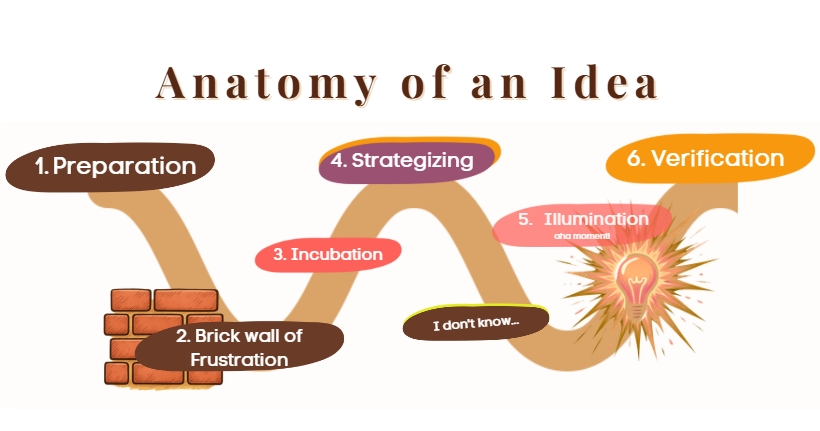
Every idea that leads to real change follows a process, whether we recognize it or not.
1. Preparation
This is where the idea is born.
There’s curiosity, excitement, and hope. You gather information. You imagine possibilities. Things feel doable—maybe even obvious. Planning happens.
This phase feels good. It’s motivating. And because it feels good, we assume the rest should feel this way too.
It won’t.
2. Frustration (The Brick Wall Stage)
This is where reality pushes back.
The plan doesn’t work the way you expected. The results aren’t immediate. The advice that should help… doesn’t. You don't have the time. You can't…
This is the phase that feels like hitting a wall.
You start thinking:
Why am I doing this? (This is actually a VERY important question.)
What am I missing?
Am I doing something wrong?
This is the brick wall of frustration—and it’s not a sign to quit.
It’s the threshold to the next stage.
3. Incubation
This is the part no one talks about. The phase where you actually… don’t know. You cannot see the next step clearly no matter how hard you try.
The actual definition of incubate is: to maintain something under conditions favorable for hatching, development, or reaction.
That is exactly what you must do with your idea. Put it away. Let it simmer. Let it incubate until conditions are favorable for it to hatch, develop, or inspire.
From the outside, it looks like nothing is happening. Internally, you've put your subconscious mind to work.
4. Strategy Supports the Process (Not Replaces It)
During incubation, strategy still matters—but not in the way we usually think.
There are three kinds of strategies that support the actual process of an idea:
Intellectual strategies: research, call in someone who has already done what you want to do, brainstorm, reflection, map it out on paper
Physical strategies: movement or exercise, yoga, running, take a walk in nature—physical exertion
Spiritual strategies: stillness, prayer, meditation, breathwork, visualize, journal
These strategies don’t create clarity. They create the conditions for clarity to emerge.
Have you ever tried so hard to remember something—a name, a place—and it just wouldn’t come?
Then later, when you’re on a walk or in the shower, it suddenly pops into your brain…
That’s because you stopped forcing it.
The moment you move your body or shift into relaxation, your nervous system softens. Your brain moves out of pressure mode and into integration mode. And that’s where the aha lives.
Sometimes the way past the wall isn’t pushing through. It’s stepping back to see the path around it—or over it. These strategies help you find the space for an aha to appear.
5. Illumination
This is the moment people romanticize—the aha.
Clarity appears. Something clicks. The next step becomes obvious. This is a huge celebration moment. The curtain is lifted!
What’s often missed is this truth: illumination doesn’t come from nowhere.
It’s the result of everything that came before it—especially the patience of incubation. Sometimes I have to go a few rounds of incubation and strategy before an idea evolves and hatches, but I don't give up.
For a season I had to work around healing as I maintained muscle and physique. Healing was urgent and important, but an absolute brick wall when it came to my fitness routine. It took months of working my way around that brick wall before really figuring out a new flow. Knowing my inner critics, and anticipating the obstacle in this season kept me on point time and again.
I knew the wall was there. I didn't let it stop me. That's my hope for you—that the brick wall becomes visible… not an impossible hurdle.
6. Verification
This is where the idea becomes real.
You test it. You live it. You adjust and refine. The idea takes form in the world. You do what you set out to do no matter how long it takes! You change, grow and find the “balanced life” that comes from recognizing things like brick walls and reigning in your inner self-talk.
And then—eventually—the cycle begins again. Because growth doesn’t end. It deepens.
You're on your way to new heights with a deeper understanding of this concept.
Trust the Process
If you begin with the concept of an idea or the end product of the idea in mind, trust these six steps to guide you to answers, pivots, aha moments, and fruition!
Understanding this pattern of life and how an idea really develops will help you create new outcomes and reach new goals. I’d love to hear about how it works!
If You’re at the Brick Wall Right Now
If you’re frustrated. If you can’t see the way forward. If the right things aren’t working anymore…
Pause before you assume failure.
You may not be stuck. You may be early. You may need incubating.
And incubation, while uncomfortable, is where real change is born.
Nothing has gone wrong. Something is still forming.
Keep going and trust the process.