
The Skill Most People Skip: Detached Observation

Are you tired of starting over?
Tired of wanting to change — your body, your habits, your consistency, your mindset — only to find yourself back in the same place again?
If that’s you, hear this clearly:
You are not the problem.
The issue isn’t your discipline.
It isn’t your willpower.
It isn’t that you “just don’t want it badly enough.”
The real issue is your thinking.
Most of our thoughts are habitual, automatic, and running in the background. In fact, a large percentage of our daily thinking is repetitive — the same interpretations, the same assumptions, the same internal commentary — playing on a quiet loop.
Those thoughts are:
generated before you’re consciously aware of them
shaped by conditioning and emotional experience
evaluated only after they’ve already influenced how you feel and behave
And if you don’t know they’re running, they get to drive.
Detached observation is the skill that interrupts that pattern.
It’s the practice most people skip — and the shift that changes everything.
The moment you step back, look at a thought clearly, and realize: I cannot believe I say this to myself. I don’t believe this is true. You are no longer reacting to your thinking, you are observing it and you are aware of it. Once you’re good at detached observation, you realize you can change or redirect the thoughts you think…and where they lead you.
That’s where life change begins.
What Detached Observation Actually Means
(And What It Doesn’t)
Detached observation is the ability to notice a thought without becoming upset by it.
You’re not:
believing it
fighting it
shaming yourself for having it
You’re simply observing it from the outside. You are looking at what you are saying to yourself in your inner dialoge, possibly for the first time.
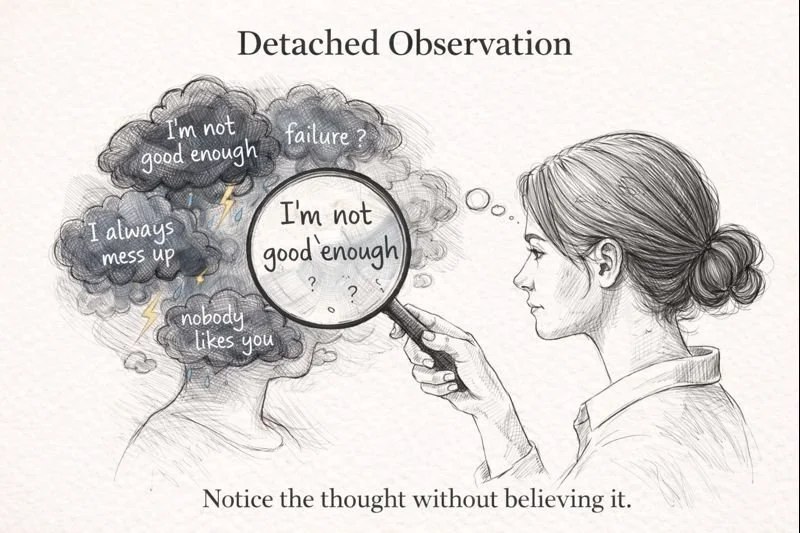
A thought appears:
You step back
You look at it instead of reacting
Detached observation is not:
thought suppression
positive thinking
emotional numbing
pretending the thought isn’t there
It’s awareness without entanglement. It’s hearing the thought and realizing you don’t agree with it, or you don’t believe it, and you won’t let it ruin your day. You don’t let this thought ‘drive’ your day. (Does this ever happen to you, or is it just me?!)
Why Your Thinking Feels So Convincing
When you first notice those negative thought loops, they don’t feel like “a thought.” They feel like truth, or normalcy.
“I always mess things up.”
“I’m not good enough.”
“Everyone else has this figured out.”
“That never works for me”
These thoughts feel real because they are on a 24/7 loop in your mind whether you are aware or not. These thoughts are familiar, and they are reinforced by how you feel.
Detached observation allows you to separate from this constant thinking and notice it, and then you have an opportunity to get curious and question why the thought is even in your mind! Once you do this, your thinking cannot be ‘unseen’. It can be unsettling to notice how critical we can be of ourselves.
The Moment You Get Curious
Once you realize you ARE NOT THE VOICE, there is a shift. You’ s questioned and you realize you are the one listening to this voice. You are the OBSERVER!
This is the moment everything shifts.
Instead of: I’m not good enough.
You experience: I’m noticing a thought that says I’m not good enough.
Then you question: Why am I saying that?
And you create space in your mind that allows you to stop reacting and start responding to people, situations, ideas, and to yourself. You might have that repeating thought in a critical moment, and instead of giving in to it, you NOTICE IT, and you do your thing anyway!
That subtle difference is identity work.
You are no longer the voice. You are the one listening to the voice.
What Changes When You Observe Instead of React
When you practice detached observation, several things happen naturally:
Repetitive thoughts lose emotional charge
You gain bounceback time
You stop spiraling
Choice becomes available
You don’t have to force calm. Your nervous system settles because you’re no longer under attack from yourself, and you don’t feel like you’re under attack anymore.
This is why awareness is powerful — and when it’s detached from an emotional response, our awareness will allow us to make different decisions in the moment.
How Detached Observation Disarms negative thinking
Negative thought loops, or what I like to call ‘the inner critics,’ survive on you not understanding a repeating thought is there, or you not understanding how to release it.
Sometimes a negative thought we have is a downright belief. This happens when you repeat a thought to yourself over and over - you begin to believe it. Over time, you may believe it strongly.
Detached observation allows us to notice a pattern of thinking, and when we use curiosity, it helps us quiet the inner critic AND dismantle what might be an underlying belief in our lives.
Instead of arguing with the thought, you’re thinking:
Interesting. That’s here…again…
Instead of defending yourself, giving up, or procrastinating, you’re thinking:
I can do this anyway. I don’t even think that limiting thought is true.
The negative thinking, or inner critic, loses authority not because you defeat it,
but because it no longer hums in the background. You can notice and dismiss the voice/thought. (I love using the 5 Second Rule Here!)
How to Stop Negative Thought Loops With Detached Observation
You don’t need a long meditation or a special setup.
Try this:
Notice the thought
Name it - Angry Alice or Unsatisfied Elsa
Create distance with language
Examples:
“I’m noticing a thought that says…”
“That sounds angry…Angry Alice will work…”
“This is a pattern I recognize when I...”
That’s it.
The goal isn’t to change the thought yet.
The goal is to step out of it.
Why This Is Where Change Actually Happens
Once you notice and get curious, you’ve dissloved your self judgement. You’ve taken the anger, aggravation, disapointment, or dismissive thought out of the way you are speaking to yourself. And you have an aha moment, “There it is AGAIN!”
It’s like you’ve caught the thought in action. This changes how you feel, and therefore, how you act next.
So maybe you move forward, get to the gym, set the goal, do the thing all because you didn’t stop and spiral when you hit a brick wall of frustration.
You regrouped and moved on.
This takes you from reacting to responding.
Detached observation is the doorway to responding on YOUR TERMS vs reacting the way you always have.
With detached observatoin, you get to choose to:
dismiss
reframe
set a boundary
take action
invite compassion
This is where the old repetitive thinking, or the inner critic, loses its grip.
Detached Observation Is Not Passive — It’s Powerful
You’re seeing your thinking clearly, and that changes how you feel and behave.
Detached observation says:
I can see you Angry Alice — you always show up, and you don’t get to decide how I feel for the rest of the day.
Where to Start
If this idea resonates but feels abstract, that’s normal. This is a practice, not a concept to master in one sitting.
If you haven’t yet, begin with the Inner Critic Exercise. It’s designed to help you practice noticing, observing, and responding — in real time.
And when you’re ready to go deeper, the Inner Critic + Mindset Deep Dive will walk you through how to integrate this work into daily life, habits, and decision-making.
Final Thought
You don’t need to silence the inner critic or negative thought loop.
You don’t need to fix yourself.
You need a bounce back shield from your own thinking.
Detached observation gives you that bounce back buffer. You bounce back from the negative thoughts that are plaguing you more and more quickly with practice.
That’s where transformation happens - when you’ve got space to really think.